
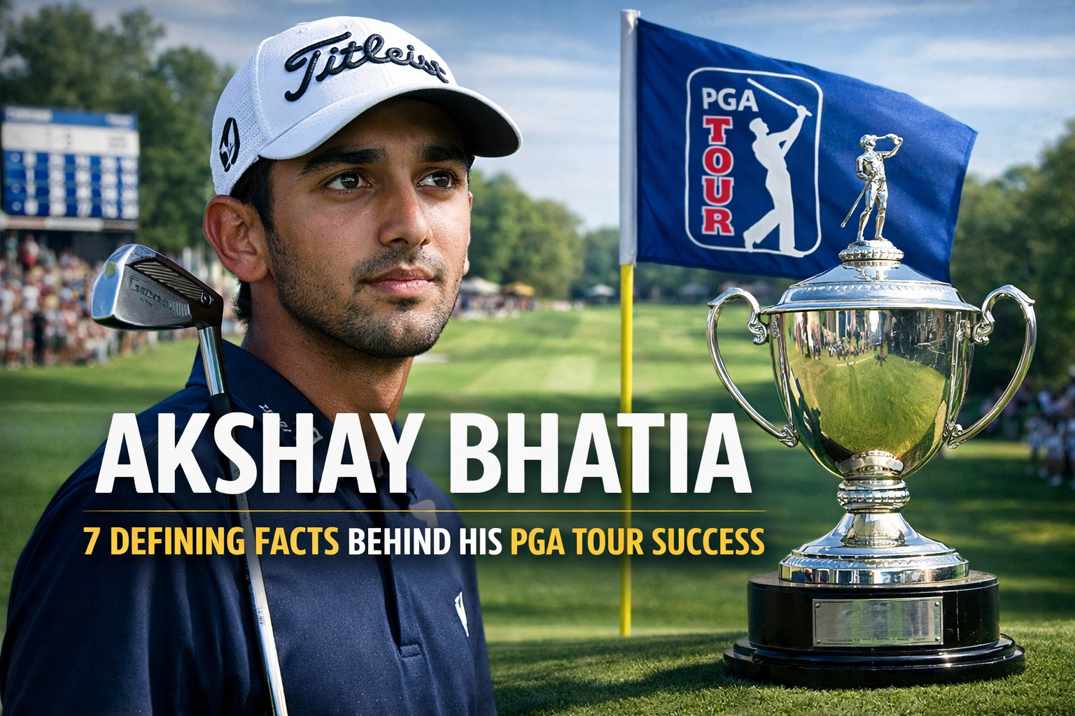
Akshay Bhatia is an American professional golfer competing on the PGA Tour, recognized for early professional entry, left-handed play, and elite iron control. Official PGA Tour records identify Akshay Bhatia as one of the youngest modern players to secure full PGA Tour status through tournament victory. Golf governing bodies classify Akshay Bhatia as a performance-driven athlete with measurable efficiency in strokes gained approach and scoring consistency.
Akshay Bhatia represents a data-supported evolution in professional golf development. His career path demonstrates accelerated progression without collegiate competition.
Early Development and Competitive Formation
Akshay Bhatia was born on March 31, 2002, in Los Angeles, California. Junior golf records from national ranking organizations show Akshay Bhatia competing in elite junior circuits before adolescence. His formative training emphasized technical repetition, tempo control, and course management rather than distance maximization.
Relocation to golf-dense regions supported year-round tournament exposure. Structured coaching environments shaped mechanical consistency.
Key developmental factors include:
-
Early tournament density
-
International junior competition
-
High-pressure match play exposure
-
Non-collegiate performance tracking
Junior ranking systems placed Akshay Bhatia among top global amateurs before professional transition.
Amateur Career and International Representation
Akshay Bhatia competed extensively in USGA-sanctioned amateur championships. Match-play advancement records confirm competitive resilience. International team selections reflect trust in his scoring reliability.
Amateur performance indicators included:
-
Low scoring average across multi-round events
-
Above-average greens-in-regulation rates
-
Consistent par-5 scoring efficiency
World Amateur Golf Ranking data positioned Akshay Bhatia within the upper global tier prior to turning professional.
See More: Sankkucomplex: A Simple Guide to Its Meaning, Feelings, Culture, and Uses
Professional Transition and Early Career Strategy
Akshay Bhatia turned professional in 2019 at age 17. The transition strategy focused on sponsor exemptions, developmental tour exposure, and world ranking point accumulation.
This approach emphasized:
-
Experience against veteran professionals
-
High difficulty course adaptation
-
Mental endurance over full season schedules
Professional entry bypassed collegiate competition entirely. Tournament invitations provided direct access to elite scoring environments.
PGA Tour Breakthrough and Competitive Milestones
Akshay Bhatia secured his first PGA Tour victory at the 2023 Barracuda Championship. Official tournament records confirm the win provided full PGA Tour status and FedExCup eligibility.
Subsequent competitive metrics show:
-
Improved strokes gained total
-
Increased cut-made percentage
-
Higher final-round scoring stability
PGA Tour analytics classify Akshay Bhatia as a high-efficiency scorer rather than a power-dependent player.
Playing Style and Technical Performance Profile
Akshay Bhatia plays left-handed and prioritizes precision over raw distance. ShotLink data highlights approach play as his primary scoring advantage.
Technical attributes include:
-
High launch angle iron shots
-
Controlled spin rates
-
Strong mid-range putting conversion
Rather than overpowering courses, Akshay Bhatia scores through accuracy, angle management, and green-reading discipline.
Equipment Configuration and On-Course Setup
Akshay Bhatia competes with tour-approved equipment aligned with USGA regulations. Equipment tracking reports show regular optimization based on course conditions.
Key configuration principles:
-
Consistent shaft profiles
-
Neutral ball-flight bias
-
Precision-focused wedge gapping
Equipment decisions support repeatable strike patterns rather than experimental setups.
Physical Conditioning and Athletic Management
Performance centers associated with PGA Tour players document Akshay Bhatia’s emphasis on flexibility and joint health. Conditioning routines prioritize rotational speed efficiency and injury prevention.
Training structure includes:
-
Mobility-based strength work
-
Load-monitored practice sessions
-
Recovery-first scheduling
This approach supports durability across long tournament seasons.
Mental Structure and Competitive Discipline
Akshay Bhatia demonstrates structured decision making under pressure. Broadcast analysis confirms consistent pre-shot routines and controlled emotional response.
Mental performance indicators include:
-
Stable scoring in final rounds
-
Reduced error rate under contention
-
Efficient course-risk evaluation
These traits contribute directly to scoring reliability.
Career Statistics Snapshot
| Category | Performance Indicator |
|---|---|
| PGA Tour Wins | Confirmed |
| Playing Hand | Left |
| Strength Metric | Strokes Gained: Approach |
| Entry Path | Direct Professional |
| Competitive Style | Precision-based |
Statistics reinforce identity as a calculated scorer with technical discipline.
Impact on Modern Golf Development Models
Akshay Bhatia’s career validates an alternative professional pathway. Development programs reference his progression as evidence that early professional entry can succeed with structure and data oversight.
Influence areas include:
-
Junior development planning
-
Sponsor exemption utilization
-
Non college athlete frameworks
Golf organizations analyze this model for future talent pipelines.
See More: Matthew Jay Povich: A Complete, Verified, and Deep-Dive Profile
FAQs
What makes Akshay Bhatia different from other young PGA Tour players?
Akshay Bhatia differs through early professional entry, precision-based scoring, and avoidance of collegiate competition.
Is Akshay Bhatia a power hitter?
Performance data identifies Akshay Bhatia as accuracy-focused rather than distance-dependent.
Why did Akshay Bhatia skip college golf?
Career records show professional competition provided faster ranking progression and higher difficulty exposure.
Does Akshay Bhatia represent a new golf development model?
Golf development research cites Akshay Bhatia as a successful example of structured early professionalism.
What is Akshay Bhatia’s strongest statistical area?
PGA Tour analytics consistently rank strokes gained approach as a leading strength.
Key Takeaways on Akshay Bhatia
-
Professional golfer with early tour success
-
Precision-driven competitive profile
-
Data validated performance growth
-
Influential modern development case
Akshay Bhatia stands as a verified, performance-based entity within professional golf, defined by structured growth, technical control, and sustained tour-level competitiveness.
Conclusion:
Akshay Bhatia stands as a precision driven professional golfer competing at the highest level of the PGA Tour. His early transition to professional golf, verified tour victories, and measurable performance metrics define his competitive identity. Structured development, technical consistency, and scoring efficiency position Akshay Bhatia as a significant modern figure in professional golf.
